Home · Research tools · InvestingPro review · WarrenAI
On this page
- What we found
- Case one: Apple, and the contradiction inside a single answer
- Case two: Intel, where the reversal flips the thesis
- Case three: ASML, with a caveat we should state
- The control: Nvidia, where nothing went wrong
- What we think is happening
- What it is like to use, beyond the error
- Verdict
- How we tested this
What this covers. WarrenAI is the research assistant inside InvestingPro, the premium subscription of Investing.com. An unrelated portfolio management product also uses the InvestingPro name on software directories. It is not the subject here.
What we found
WarrenAI answers research questions in a fixed structure: a bold summary paragraph at the top, then sections of bullets, charts, and a closing take. We tested it across four companies on 10 and 11 August 2026 as part of our InvestingPro review. Investing.com's own marketing figures are checked against what we counted on the claims checked page. For contrast, every percentage we checked on Stock Analysis across three companies computed correctly.
The underlying data was accurate. Quarterly figures matched, fiscal periods were named explicitly, valuation multiples were right, and the qualitative analysis on a struggling company was direct rather than flattering. The failure sits in one place only, and it is the place most readers look first.
| Company | What the summary said | What the platform showed |
|---|---|---|
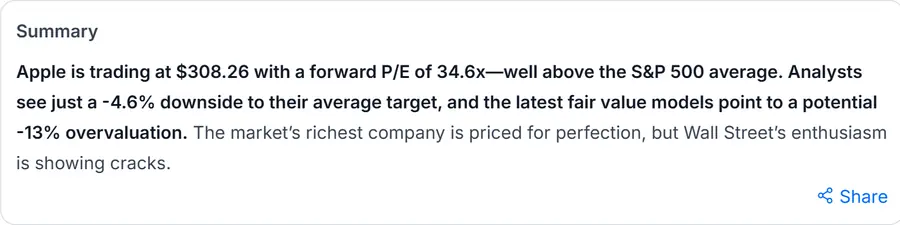
| Apple 10 Aug | Analyst mean $322.82 against -4.6%, alongside commentary describing mild upside | Base for the percentage not visible in the capture |
| Apple 11 Aug | Analysts see just a -4.6% downside to their average target | Same answer, further down: $322.53, just 4.6% upside. Sidebar: +4.55% |
| Intel 11 Aug | Price of $97.52 now sits nearly 31% below fair value models | Sidebar: Fair Value Overvalued, Fair Price 67.57, Upside -30.71% |
| ASML 11 Aug | Analyst targets signal -8.4% downside | Sidebar: Analysts Sentiment Strong Buy, Upside +21.47% |
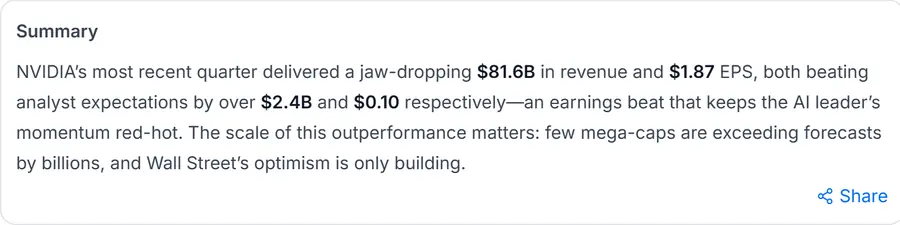
| Nvidia 11 Aug | Revenue $81.61B and EPS $1.87, both beating forecasts | Consistent throughout. No error found. |
Case one: Apple, and the contradiction inside a single answer
We asked whether Apple was overvalued and what analysts thought. The summary paragraph at the top of the answer read that analysts see just a -4.6% downside to their average target.
Further down, inside the same answer, the analyst targets bullet read that the average price target is $322.53, just 4.6% upside.
Same figure, opposite sign, one response. The body is the one that is right: the answer states the price as $308.26, and $322.53 against $308.26 is 4.63 percent above, not below. Investing.com's own sidebar on the Apple page agreed at the same moment, showing a price target of 322.28 with an upside of +4.55%.
Two of the three displays were correct. The one that was wrong was the summary, which is the part most readers read and the only part many will read.
Case two: Intel, where the reversal flips the thesis
We asked whether Intel was a good investment and what the risks were. The analysis that followed was the strongest thing we saw from the product: it named the dilution, the debt, the absence of profitability over twelve months, and the absence of a dividend, and it gave the full analyst target range from $65 to $200 rather than only the mean. The closing take said the valuation was hard to justify without flawless execution ahead.
The summary paragraph said something else entirely.
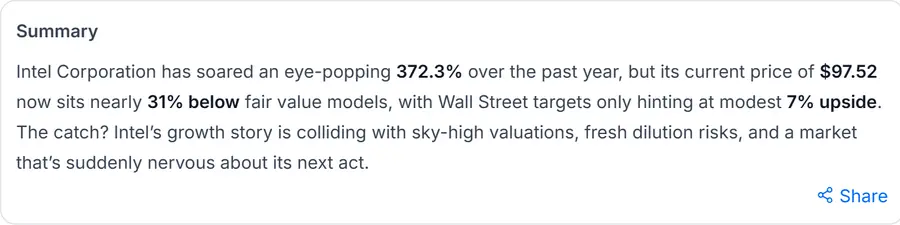
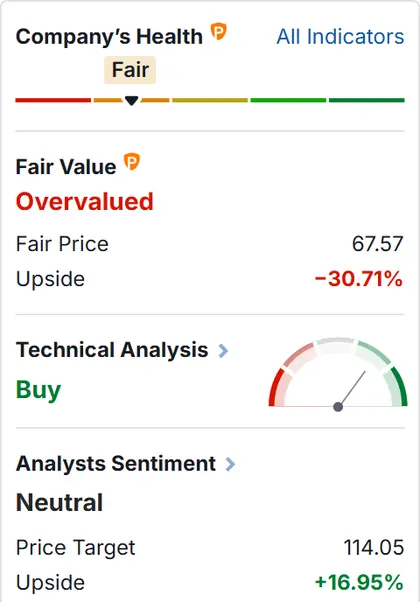
The magnitude matches almost exactly: 30.71 against nearly 31. The direction does not. A price sitting 31 percent below fair value describes a cheap stock. Investing.com's own sidebar labelled Intel Overvalued.
This is the case that matters most, because the reversal does not merely flip a number. It flips the conclusion. A reader who reads only the summary comes away believing Intel trades at a 31 percent discount, when the product they are paying for classifies it as expensive.
Case three: ASML, with a caveat we should state
We asked the same question we asked about Apple, word for word, to see whether depth held outside the United States. It did. The answer named the price, the multiple, the fair value range, the analyst targets, the specific risks flagged by Citi and BofA, and the competitive pressure in DUV lithography.
The summary said analyst targets signal -8.4% downside. Investing.com's sidebar showed Strong Buy with an upside of +21.47%.
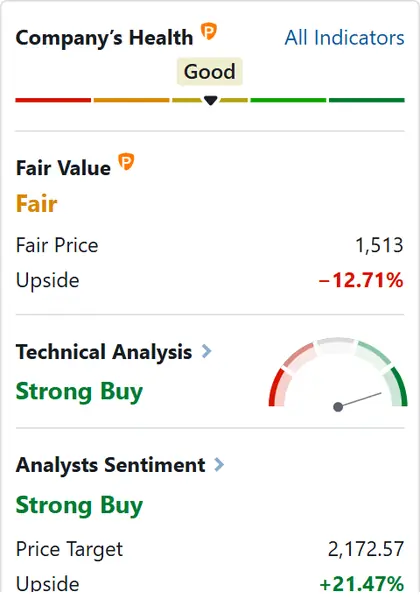
The caveat. WarrenAI answered on the US listing, quoting a price of $1,733.48. The sidebar we captured is the Amsterdam listing, priced in euros. The two are not directly comparable, so unlike the Apple and Intel cases the magnitudes here cannot be checked against each other. What can be checked is the direction, and the direction is opposite: the platform rates analyst sentiment Strong Buy with positive upside while the summary reports downside.
And a point in the product's favour. In the same summary, the fair value figure was right. It said models see -12% to -13% risk, and the sidebar showed -12.71%. The error is concentrated in the analyst target field, not spread across everything.
The control: Nvidia, where nothing went wrong
We asked for Nvidia's most recent quarterly revenue and EPS against expectations. The answer gave revenue of $81.61B against a forecast of $79.19B and EPS of $1.87 against $1.77, named the fiscal period explicitly as Q1 FY2027, and described the result as a $2.4B revenue beat and a 6 percent EPS surprise. The arithmetic checks out in both places, and the summary and the body agreed with each other.
This matters more than it looks. It rules out the simplest explanation, which would be that the summarising layer is unreliable in general. It is not. It handled a straightforward reporting question cleanly. The failures cluster around one specific operation: describing a signed percentage in words.
What we think is happening
We are describing a pattern, not diagnosing a codebase, and the distinction matters.
Inside InvestingPro, both fair value and analyst upside are displayed with a signed percentage. On the fair value line a negative number means the stock trades above fair value, which is bad news. On the analyst line a positive number means the target sits above the price, which is good news. The two fields use the same visual convention for opposite kinds of information.
In all three failures, the magnitude survived and the interpretation did not. That is the signature of a translation step that reads the number and loses what the sign refers to, rather than of a calculation error. The calculations were right everywhere we could check them.
What it is like to use, beyond the error
- Credits. 500 a month on the tier tested. The counter read 10 of 500 at the start of both sessions, which suggests a monthly reset. Four substantial questions consumed a small fraction of the allowance, so for a normal research workload the limit is unlikely to bind.
- It says what it does not know. Every answer closed with a line stating that historical data is limited to 10 years on the Pro+ plan, unprompted. Volunteering a limitation is good behaviour and worth crediting.
- It does not flatter. The Intel answer named unprofitability, dilution and a shaky consensus without softening any of it. A research assistant that describes every company as an opportunity is worthless, and this one is not that.
- Sourcing is visible. Analyst views were attributed to named institutions with dated links to the underlying articles.
- The charts are weak. Across the answers we saw one chart with no title, one showing a flat line that reads as a missing data point rather than a trend, and a price chart with a y axis starting at zero, which flattened a fifteen percent quarterly move into a nearly straight line.
- The tone runs hot on winners. Nvidia was an AI darling obliterating forecasts. That register does not help anyone make a decision, and it sits oddly beside the careful Intel analysis.
Verdict
WarrenAI is a capable research assistant with accurate underlying data and a specific, reproducible flaw in the layer readers see first. Three point five out of five.
Use it if you read past the summary. The bullets, the analyst attribution and the risk sections were solid across every company we tried, including one outside the United States and one in genuine difficulty.
Be careful if you skim. The summary paragraph is bold, sits at the top, and was wrong about direction in three of four answers. On Intel it would have left a reader believing a stock the platform itself calls overvalued was trading at a 31 percent discount.
The practical rule: when the summary states a percentage, check it against the sidebar on the company page before you act on it. That takes five seconds and it is the whole of our advice on this product.
This is on our list for the 90 day recheck on 8 November 2026. If it is fixed by then we will say so here with the same prominence, and log the change at the correction log.
Paid link. The sign error above is published unchanged because of it, not despite it · 11 Aug 2026
Common questions
Is WarrenAI accurate?
The underlying data was accurate in every check we made. Quarterly revenue and EPS matched against forecasts, fiscal periods were named explicitly, and valuation multiples agreed with the platform. The problem is narrower: in three of four answers on 11 August 2026, the bold summary paragraph described a percentage in the wrong direction, reporting downside where the platform itself showed upside, and below fair value where the platform labelled the stock overvalued.
Does WarrenAI make up numbers?
We found no evidence of invented figures. Asked for Nvidia's most recent quarterly results, it returned revenue of $81.61B against a $79.19B forecast and EPS of $1.87 against $1.77, and named the fiscal period as Q1 FY2027 rather than leaving it vague. Every answer also closed by stating unprompted that historical data is limited to 10 years on the Pro+ plan.
How many WarrenAI credits do you get?
500 a month on the tier we tested. The counter read 10 of 500 at the start of two separate sessions, which suggests a monthly reset. Four substantial research questions consumed a small fraction of the allowance, so the limit is unlikely to bind for normal use.
Does WarrenAI cover companies outside the United States?
Yes, and at comparable depth. We asked the identical question about Apple and about ASML, a Dutch company, and the answers were similar in structure and detail: price, multiples, fair value range, analyst targets, named institutional views and specific competitive risks. Global coverage is the clearest structural advantage InvestingPro has over US focused research platforms.
Is WarrenAI worth paying for?
It is not sold separately, so the real question is whether InvestingPro is worth its price, and that depends on how often you research individual companies. As a component, WarrenAI adds genuine value if you read the full answer rather than the summary. The bullets and risk sections were reliable across every company we tested, including one in real difficulty where the analysis was direct rather than flattering.
What is the difference between WarrenAI and ProPicks AI?
WarrenAI answers research questions you ask about companies you choose. ProPicks AI is a catalogue of rules-based strategies that select stocks on a schedule, which we cover separately in our ProPicks AI review. They are different products inside the same subscription and the performance figures published for ProPicks require their own careful reading.
How we tested this
Method. Two logged-in sessions, 10 and 11 August 2026, on one account. Four companies: Apple, Nvidia, Intel and ASML. The Apple and ASML questions used identical wording so that any difference in depth would come from the company rather than the prompt. Every figure quoted here was read on screen and captured.
Corroboration. Each disputed percentage was checked against Investing.com's own sidebar on the same company page at the same time, so the comparison is the product against itself rather than against our arithmetic. Where the two could not be compared cleanly, as on ASML, we say so above rather than presenting it as though they could.
What we are not claiming. We are not claiming the product miscalculates. The calculations were correct everywhere we could check them, including in the body of the same answers whose summaries were wrong. We are reporting a reproducible failure in how a signed percentage is described in words.
Access. Platform access was arranged through an affiliate partnership with Investing.com. Investing.com did not see this page before publication, was not given advance notice of the finding, and has no approval over its contents.
Written by Jacob Shasha, who builds and maintains feequity and invests his own money. Not a licensed financial adviser · how we are paid is set out at how we make money · methodology at how we test · last checked 11 August 2026